The product
From a raw document to an answer you can verify.
Four steps, no magic. What follows describes exactly what the platform does between the moment a file arrives and the moment someone on your team reads an answer with its sources.
The journey of a document
- 1
It arrives
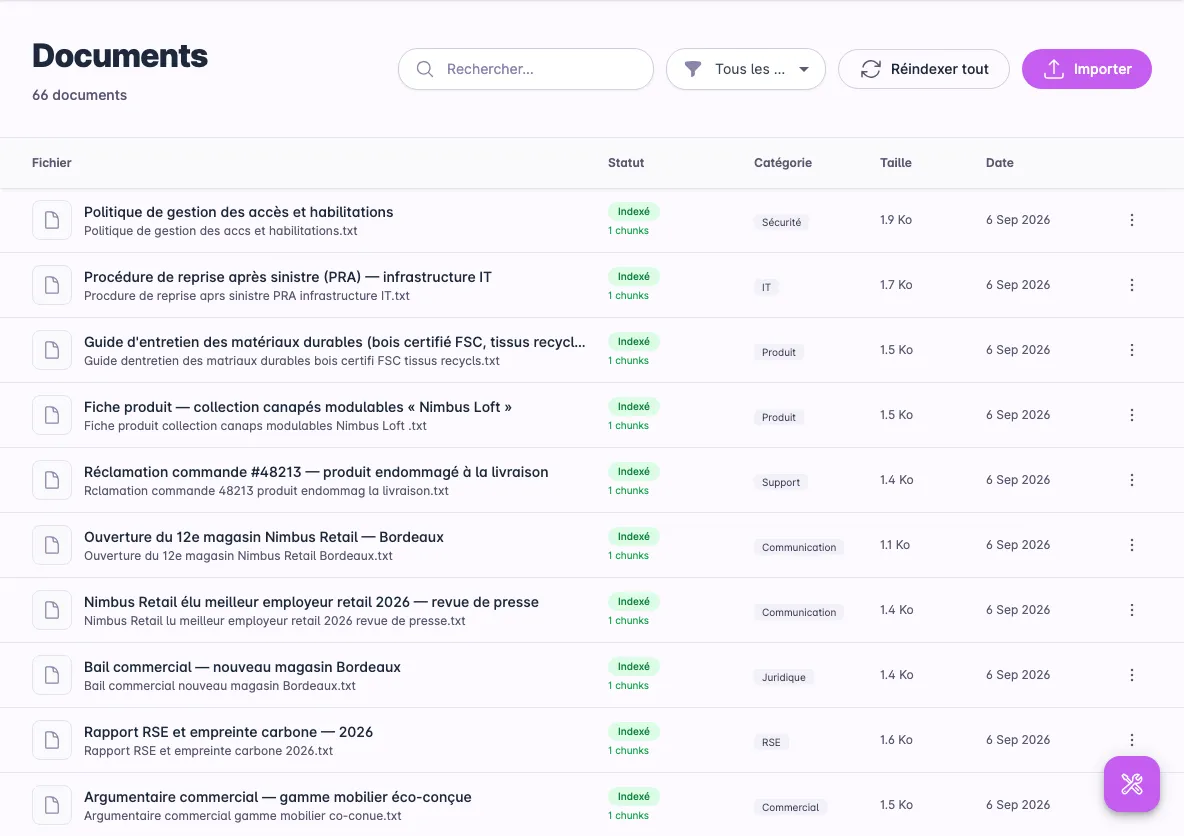
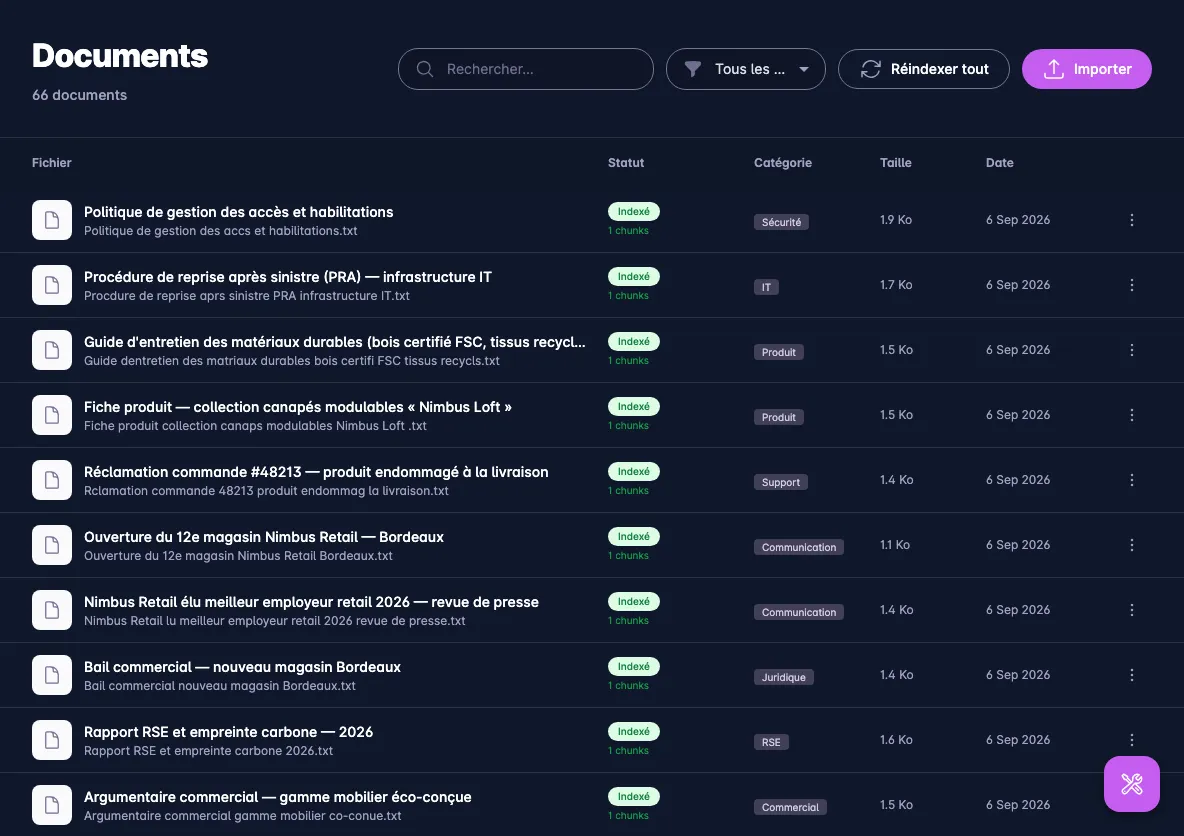
Dropped into the interface, or synced from a mailbox, an RSS feed, a OneDrive or a SharePoint library. Text is extracted according to the format: PDF, DOCX, plain text, HTML, CSV, JSON.
- 2
It is chunked
The text is split into fragments of roughly 800 tokens that slightly overlap, so a sentence cut in half still makes sense in both halves. Chunk size and strategy are configurable.
- 3
It is vectorised
Each fragment becomes a vector, stored in an index dedicated to your organisation. The text itself stays in your database: it is never duplicated inside the index.
- 4
It becomes an answer
For a given question the engine retrieves a wide pool of candidate fragments, has them re-ranked by a model running on the instance, keeps only the best ones, and lets the language model answer from those alone — showing the documents it used.
Sources
Your knowledge comes from where it already lives.
A manual import to get started, then connectors that keep syncing — with filters, scheduling and permanent exclusion of a file.
File import
PDF, DOCX, TXT, Markdown, HTML, CSV, JSON, XML. Drag and drop, raw text or a public URL.
Email inboxes (IMAP)
Filters by date, sender and subject keywords. Real-time mode available.
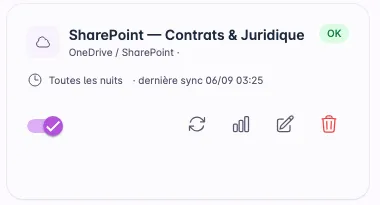
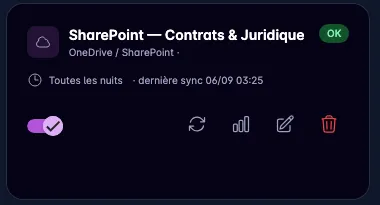
OneDrive / SharePoint
Incremental sync through Microsoft Graph, deletions propagated, no duplicate copy of your files.
RSS / Atom feeds
Industry watch or internal press review, with detection of edited articles.
A legible indexing cycleEvery document goes through Pending → Processing → Indexed, with the number of chunks produced. A failure is visible and can be replayed.
Hosting
A dedicated instance, hosted in France. Never shared.
No server to install, no IT team to mobilise: we run the instance for you. But your knowledge base, your vector index and your files are shared with no other customer.
Where your data travels
- Your sourcesFiles, emails, OneDrive/SharePoint, RSS
- Your instanceExtraction, chunking, dedicated vector index
- Your usageSourced chat, search, API, webhooks
One instance per customer
Dedicated database, dedicated vector index, dedicated storage. No pooling, no neighbours.
Nothing for you to administer
Updates, daily backups and monitoring are part of the subscription — designed for companies with no IT department.
One documented outbound flow
The call to the language model, limited to the passage needed to answer. A locally executed model is possible where your requirements demand it.
Costs
The spending cap lives in the software, not in a promise.
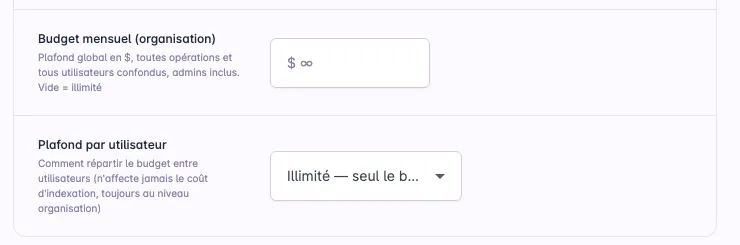
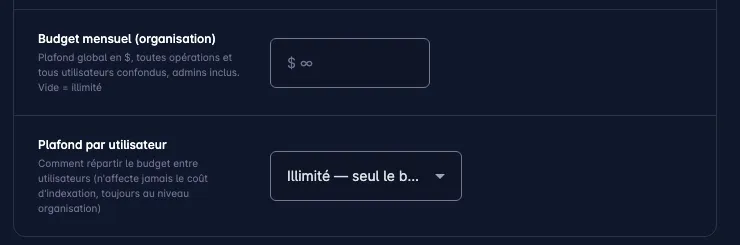
A runaway AI bill is a legitimate fear. Here the monthly budget is a setting: at organisation level, and per user if you want it. Once reached, it blocks.


- A monthly organisation budget, in euros, covering everything: chat, search, indexing.
- Per-user cap of your choosing: unlimited, a fixed amount, or an equal split of the global budget.
- Cost tracked by model, by user, by API key and by day.
- Indexing cost always stays with the organisation — it is never charged to an individual user.
And an estimated environmental impact
An awareness card shows the estimated CO₂ of your usage, with fully configurable calculation factors. Presented for what it is: an estimate, not a measurement.


Who does what
Two roles on your side
Two roles on your side, a third on ours. That is the direct consequence of the model: the instance is operated by Hekza, so you have no IT department to mobilise.
User
Asks questions, browses their conversation history, opens cited documents, manages their own two-factor authentication and preferences.
Manager
Everything above, plus: inviting and managing users, configuring data sources, creating and revoking API keys, changing the visual identity, reading the audit log and usage statistics.
Technical administration — at Hekza
Model and search engine settings, budget caps, indexing parameters, webhooks, mail, updates and backups. Included in the subscription.
Governance
What your management, your DPO and your accountant will ask for.
- Two roles on your sideManager and user — enforced server-side, not just in the interface. Technical administration stays with us.
- Two-factor authenticationTOTP with recovery codes, resettable if someone gets locked out.
- Audit logLogins, API-key access, settings changes, document deletions.
- Scoped API keyschat / documents / rag scopes, rotation and revocation, per-key statistics.
- Signed webhooksHMAC-SHA256 signature, three attempts, delivery history you can inspect.
- Exit rightsYour documents, corpus and history stay exportable. The corpus belongs to you.
- 14:32:07managerapi_key.revokedhk_18bcd7b…
- 14:04:19systemdocument.indexedWarranty procedure v4
- 11:47:52userchat.message.created3 sources cited
- 10:12:38managerdata_source.syncedSharePoint — Legal
- 09:03:40Hekzasettings.updatedrag.topK 5 → 6
- 08:55:02userauth.mfa.verifiedTOTP
Public surface
An API and webhooks, ready to be called
The platform exposes its capabilities to your other tools. The building block exists and is documented; wiring it into your information system is an integration project we quote.
- SearchSemantic search across the corpus, with document, category and tag filters.
- GenerationA sourced answer in a single call, with no persisted conversation — designed for automations.
- ChatThe same conversation as in the interface, streamed, callable from your applications.
- IngestionAdd, update or delete a document from another system.
- Signed webhooksDocument indexed, document failed, message sent, API key created — HMAC-SHA256 signature and three attempts.
- Scoped keyschat / documents / rag scopes, rotation, revocation, per-key usage statistics.
- POST/searchrag
- POST/generaterag
- POST/chatchat
- POST/embeddingsrag
- POST/knowledge/textrag
- PUT/knowledge/:idrag
- DELETE/knowledge/:idrag
Twenty minutes is enough to know whether this is for you.
We show you the tool on a demo corpus close to your line of work: a real question, its sourced answer, a question with no answer, and the cost dashboard. No commitment.