sourced answers/dedicated instance/hosted in France
The answer is already written somewhere.Finding it is the problem.
AI Knowledge Hub indexes your procedures, contracts, emails and documents so your team can query them like they would ask an experienced colleague — with every answer citing the exact document, page and passage it came from.
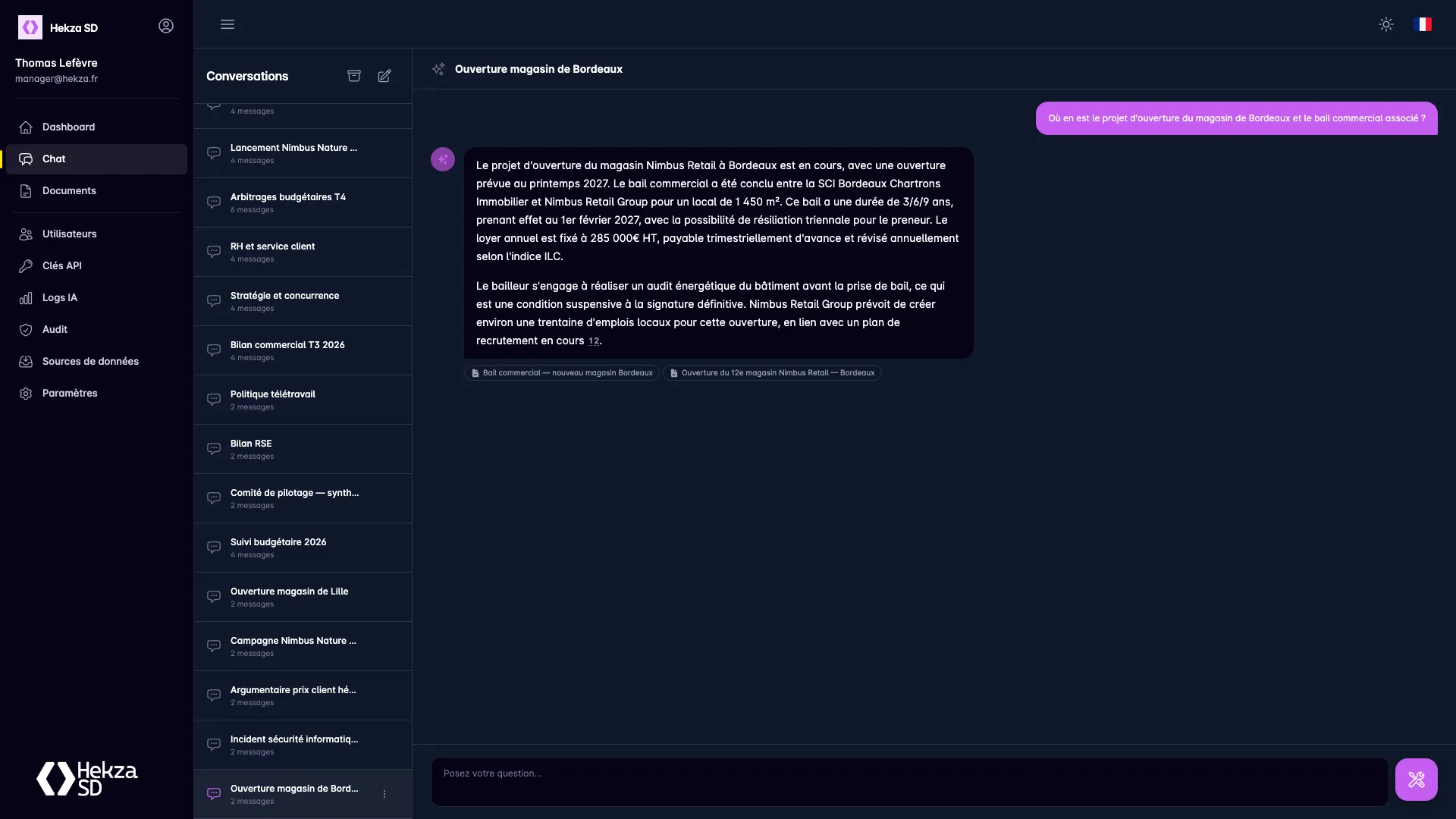
What the platform indexes
- DOCX
- TXT
- Markdown
- HTML
- CSV
- JSON
- XML
- Email inboxes (IMAP)
- RSS / Atom feeds
- OneDrive
- SharePoint
- Ingestion API
The problem
The information exists. Nobody can find it.
This is not an artificial intelligence problem, it is an access problem. The right answer is written down somewhere — in a PDF, an email, a procedure updated last year.
- 20 min
lost per search
Someone hunting for information that has already been written, several times a day, across dozens of scattered documents.
- v3 · v4
the wrong version applied
The procedure people actually follow is rarely the latest one. The cost of that mistake, however, is immediate.
- 3×/day
the same question asked
Every new hire pays the information-hunting cost again, and takes a more senior colleague down with them.
The proof
Every answer cites its source. No source, no answer.
This is the structural difference with a consumer assistant. The system only answers from passages retrieved in your own documents, it shows which ones, and when it finds nothing, it says so.
- 01
Document, page, passage
Every answer carries clickable citation chips that open the exact document the information came from.
- 02
Local re-ranking against cross-contamination
A cross-encoder running on the instance re-ranks candidate passages before answering, so two similar-looking files never get mixed up.
- 03
The refusal to answer
Ask something outside the corpus and the assistant says it has no information, instead of improvising a plausible answer.
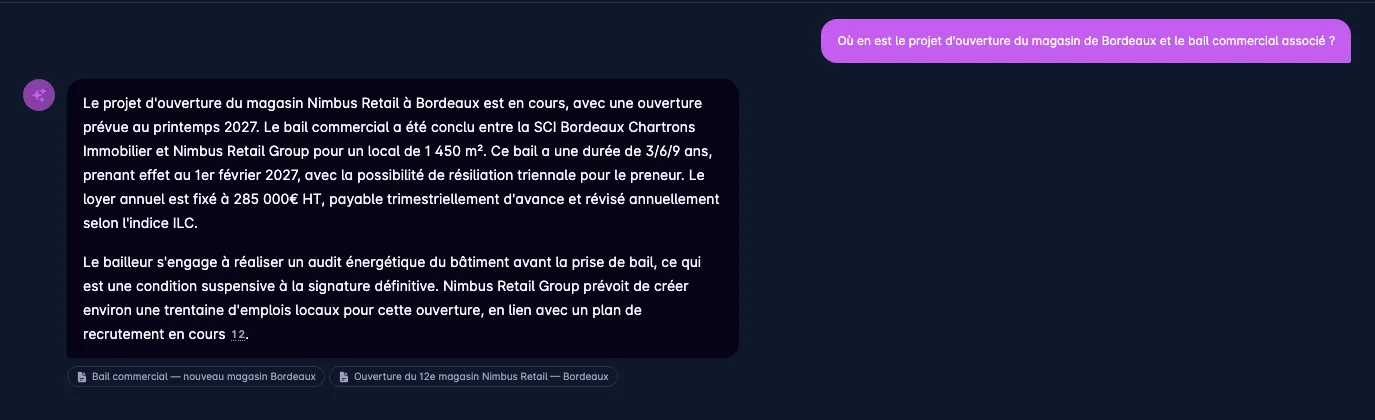
The question with no answer in the corpus
The most convincing moment of any demo: deliberately asking something the documents do not cover.


The two other questions
An instance of your own. A budget you set.
- A dedicated instance, hosted in France
- Database, vector index and storage dedicated to your organisation. No pooling, and nothing for you to administer: we run the instance.The technical detail
- A spending cap inside the software
- The monthly budget is a setting, not a promise: at organisation level, and per user if you want it. Once reached, it blocks.See cost tracking
What you get, and what gets built
On go-live day, you have a chat over your documents.
We would rather say this before you sign than after: the platform delivers a queryable knowledge base and its administration. The automations that plug that base into your other tools are integration work — we scope, quote and build them, but they are not shipped turnkey.
Shipped with the platform
- The sourced chat over your documents, with conversation history
- Semantic search and passage re-ranking
- File import and the email, RSS and OneDrive/SharePoint connectors
- The admin console: users, sources, API keys, visual identity
- Cost tracking, budget caps, audit log
- The public API and webhooks, ready to be called
Built on quote, by us
- A draft reply prepared automatically inside your ticketing tool
- A support assistant plugged into your CRM or your inbox
- n8n, Make or equivalent automations around the base
- A custom connector to your DMS, your ERP or a line-of-business tool
- Integration with your intranet or an existing internal application
These automations rely on the API and webhooks already shipped — the technical building block exists. What gets quoted is the work of wiring it into your tools, your rules and your procedures.
Use cases
What your teams actually do with it.
Three uses available from go-live, and three more we build around the base when the need justifies it.
- Included
Internal documentation
“What is the procedure for…?” — a sourced answer, taken from the latest version in the base.
- Included
Onboarding and training
A newcomer asks the knowledge base rather than an already-busy colleague, and checks where the answer came from.
- Included
Decision support
Cross-reference several documents without confusing two files, thanks to passage re-ranking.
Quoted separatelyDraft replies · Support desk assistance · Integration with your toolsSee the use cases in detail
Comparison
Elsewhere, every extra user costs more.
Indicative monthly cost for a 50-person company, based on publicly listed prices as of September 2026.
| Solution | Model | Monthly cost · 50 users |
|---|---|---|
| Glean | SaaS, per-seat billing | ≈ €2,300 |
| Dust | SaaS, per-seat billing | ≈ €1,450 |
| ChatGPT Enterprise | SaaS, per-seat billing | ≈ €1,250 |
| AI Knowledge Hub | Flat fee by indexed volume, unlimited users | €290 to €790 |
With us the price follows indexed volume, not headcount: every additional user therefore lowers the cost per head, and AI usage is part of the amount. Competitor prices are indicative, publicly listed, and exclude usage.
Pricing
One setup fee, then a subscription by volume.
Excluding VAT, 12-month term. Nothing is billed per user: every new joiner lowers the cost per head instead of raising it.
Setup
€1,900one-off
Monthly subscription
€290up to 2,000 indexed documents · or ~10 GB
Where to start
The documentation AI diagnostic
€1,500 excl. VAT3 days · delivered within a week
We do not run free demos on your documents: we run a paid diagnostic, fully deducted from the project if you sign within 30 days.
Book 20 minutes- A map of your knowledge sources: where the information lives, who maintains it, what is out of date.
- Three use cases quantified in hours and euros, ranked by effort versus gain.
- A real mock-up on your own documents: 20 to 50 of your files indexed, 10 questions from your teams, the answers obtained and their sources.
- An architecture and compliance note: where data lives, what goes to the model provider, what does not.
This type of diagnostic is eligible for several French public schemes supporting digital and AI transformation — we tell you which ones apply to your case.
Frequently asked
The questions people actually ask us.
How is this different from ChatGPT or Copilot?
ChatGPT knows the world, not your company: it has no idea what your warranty procedure says in its April version, and when it does not know, it offers something plausible. Copilot reads what the user can access in Microsoft 365, without passage-level verifiable citation, and knows nothing about what lives elsewhere. Here, every answer names the document, the page and the relevance score — and no source means no answer.
Concretely, what do we have on day one?
A queryable knowledge base: your documents indexed, a chat that answers while citing its sources, search, the connectors to your files, your mailboxes and your SharePoint, and the admin console that goes with it (users, budget, API keys, audit). What you do not have on that day are the automations into your other tools: draft replies inside your ticketing system, an assistant plugged into your CRM, n8n workflows. The API and webhooks exist to build them, but that wiring is an integration project we scope, quote and deliver separately.
Who administers the tool?
You have two roles: the manager, who invites users and manages data sources, API keys and the visual identity; and the user, who asks questions and reads documents. Technical administration — model settings, budgets, indexing parameters, webhooks — stays with us: that is the operation of the instance, and it is part of the subscription. So you need no IT skills in-house.
Where is our data hosted?
On a dedicated instance that we operate in France: dedicated database, dedicated vector index, no pooling with any other customer. The only outbound flow is the call to the language model, limited to the passage needed to answer, and documented in the architecture note we hand over before signature.
What if the AI makes something up?
The answer is not “our AI never gets it wrong”, it is structural: the system only answers from passages retrieved in your documents, it shows which ones with their score, a local re-ranking step discards passages that look similar without matching, and with no retrieved source there is no answer. It is demonstrable live, and it is the first thing we show.
What does AI usage really cost?
Nothing beyond the subscription: a fixed €60 per month is part of it, and that is exactly the ceiling set inside the instance before go-live. We never re-bill at cost, so there is no surprise invoice — in exchange, using less than the included amount does not lower it. For scale, a 50-person company genuinely using the tool consumes €30 to €90 of model usage per month, with initial indexing costing around ten euros once. If your usage needs more, we raise the ceiling and discuss it beforehand.
Which formats and sources are supported?
On import: PDF, DOCX, TXT, Markdown, HTML, CSV, JSON, XML, plus raw text and public URLs. Continuously synced: IMAP mailboxes, RSS/Atom feeds, OneDrive and SharePoint. Excel workbooks and PowerPoint decks are not yet supported at ingestion.
What do we get back if we stop?
Your documents, your corpus and your conversation history, exportable. You remain the owner of your data and your corpus; we remain the owner of the software. It is written into the contract, with the timeframe and the export format.
Twenty minutes is enough to know whether this is for you.
We show you the tool on a demo corpus close to your line of work: a real question, its sourced answer, a question with no answer, and the cost dashboard. No commitment.